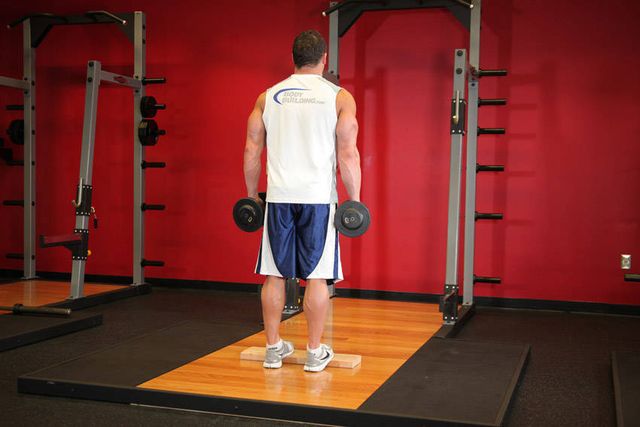
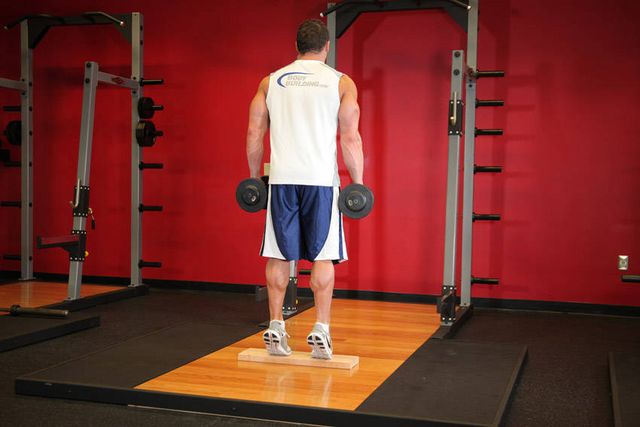
Standing calf raise
Standing Calf Raise
LegsJoint: ankle
Muscles involved, shown on the body
Body map: body-muscles (Apache-2.0) · Sources
At a glance
| Equipment | Body weight, dumbbell, or machine; preferably the edge of a step |
| Type | Single-joint |
| Chain | Closed |
| Plane of movement | Sagittal |
| Target muscle | Gastrocnemius, soleus |
Joint movements
| Joint | Going up (rising) | Returning (lowering) |
|---|
| Ankle | Plantarflexion | Dorsiflexion |
| Knee, hip, spine | Fixed | Fixed |
Muscles involved
| Role | Muscle | Action in this movement |
|---|
| Main | Gastrocnemius | Raises the heel |
| Main | Soleus | Raises the heel; lies beneath the gastrocnemius |
| Stabilizer | Muscles on the side of the lower leg and the sole of the foot | Keep the ankle from rolling sideways |
| Stabilizer | Quadriceps | Keeps the knee straight |
| Stabilizer | Gluteals and core muscles | Keep the body straight |
| Antagonist | Tibialis anterior | Toe lifter; must relax |
Origin and insertion of the target muscle
| Muscle | Upper head | Lower head |
|---|
| Gastrocnemius | Back of the lower femur (above the knee) | Calcaneus, via the Achilles tendon |
| Soleus | Back of the tibia and fibula (below the knee) | Calcaneus, via the Achilles tendon |
The toes stay fixed on the floor and the heel rises together with the whole body.
Role of the knee
The gastrocnemius crosses the knee but the soleus does not.
| Knee position | Dominant muscle | Example exercise |
|---|
| Smooth | Gastrocnemius | Standing calf raise |
| Bent | Soleus | Seated calf raise |
What must stay fixed
- Knees: straight, without hard locking and without bending and straightening.
- Ankles: rise straight up; they do not roll outward or inward.
- Torso: straight.
Phases and type of contraction
| Phase | What happens | Calf contraction |
|---|
| Going up | You rise onto your toes | Concentric |
| Pause at the top | One second | Static |
| Coming down | The heel drops below the level of the step | Eccentric |
Execution
- Place the ball of the foot on the edge of the step; heel off the step.
- Hold onto a wall for balance.
- Rise onto the toes as high as possible and pause for one second.
- Lower over two to three seconds until the heel drops below the level of the step.
Common faults
| Fault | What happens in the body | Correction |
|---|
| Bouncing up and down quickly | The Achilles tendon returns energy like a spring and the muscle does less work | Pause at the top and bottom |
| Partial range of motion | The muscle does not work in its fully stretched and fully shortened positions | Use a step |
| Bending and straightening the knee | The quadriceps helps with the rise | Keep the knee fixed |
| Ankle rolling outward | Weight falls on the little toe and the ankle becomes unstable | Pressure on the big toe and second toe |
Coaching cue for the client
“Go all the way up, pause, then come down slowly.”
← All exercises