At a glance
| Equipment | Body weight |
| Type | Isometric; no joint moves |
| Chain | Closed |
| Plane of movement | Resistance in the sagittal plane |
| Target muscle | Rectus abdominis, transversus abdominis, obliques |
Joint movements
There is no movement. Gravity tries to pull the lower back down (extending the spine) and the abdominal muscles resist this movement.
This exercise is a good example for understanding that a muscle does not always work to create movement; sometimes it works to prevent movement.
Muscles involved
| Role | Muscle | Action in this movement |
|---|---|---|
| Main | Rectus abdominis | Does not let the lower back arch |
| Main | Transversus abdominis, internal and external obliques | Tighten around the trunk |
| Synergist | Gluteus maximus | Keeps the pelvis level |
| Synergist | Quadriceps | Keeps the knee straight |
| Stabilizer | Serratus anterior | Holds the scapula against the rib cage |
| Stabilizer | Deltoid, pectoralis major, rotator cuff muscles | Hold the shoulder over the elbow |
| Antagonist | Erector spinae | Aligned with gravity and has little work to do |
Type of contraction
All of these muscles contract isometrically: they produce force but their length does not change.
What must stay fixed
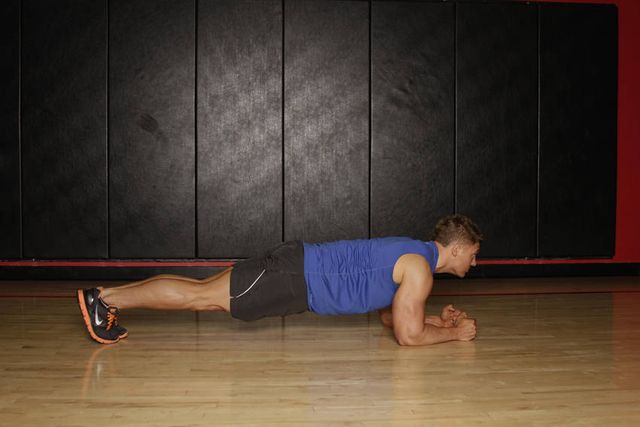
Everything. One straight line from head to heels:
- Head: in line with the spine; eyes on the floor.
- Shoulder blades: protracted and pressed against the rib cage.
- Lower back: no sagging.
- Pelvis: neither high nor low.
Execution
- Forearms on the floor, elbows directly under the shoulders.
- Legs behind you, on the toes.
- Tighten your glutes and abdominals, as if about to take a punch to the stomach.
- Push into the floor with your forearms so the scapulae do not wing out.
- Breathe slowly and steadily.
Duration
Quality matters more than time. End the set the moment the body line breaks. For a beginner, several sets of 10 to 20 seconds with correct form are better than one minute with a sagging lower back.
Easier and harder
| Level | Method |
|---|---|
| Easier | Knees on the floor; or forearms on a bench |
| Harder | Lift one leg; or move the elbows farther forward |
Common faults
| Fault | What happens in the body | Correction |
|---|---|---|
| Lower back sagging | The abdominals let go and the body hangs on the lumbar vertebrae and ligaments | Glutes and abdominals tight; easier version |
| Hips piking up | The load shifts from the abdominals to the shoulders | Bring the pelvis level with the shoulders |
| Scapulae winging | Serratus anterior is not working | Push the floor away with your forearms |
| Holding the breath | Blood pressure rises and they tire quickly | Slow, short breaths |
| Lifting the head | The neck comes under strain | Eyes on the floor between the hands |
Coaching cue for the client
“Glutes tight, abs tight, push the floor away.”