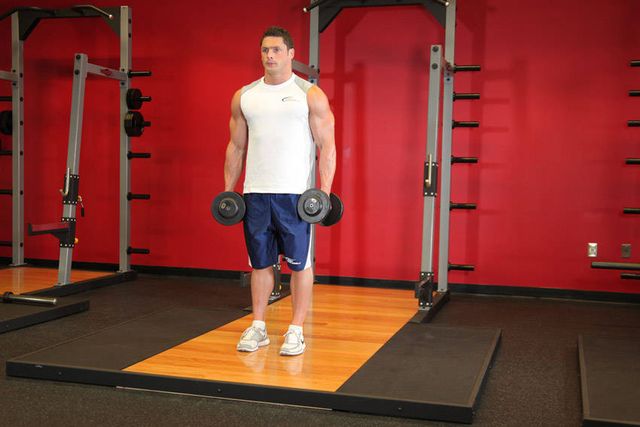
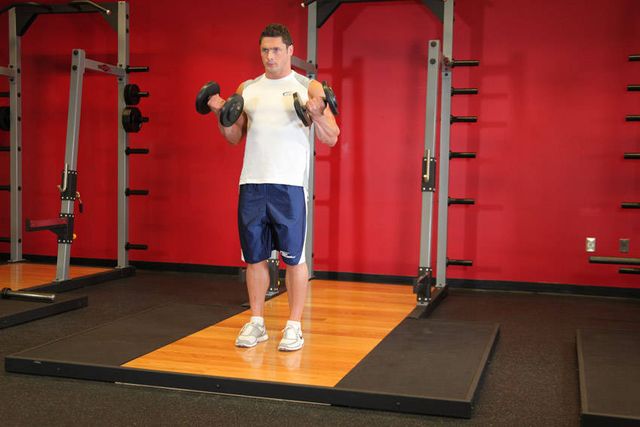
Dumbbell biceps curl
Dumbbell Biceps Curl
ArmJoint: elbow
Muscles involved, shown on the body
Body map: body-muscles (Apache-2.0) · Sources
At a glance
| Equipment | A pair of dumbbells |
| Type | Single-joint |
| Chain | Open |
| Plane of movement | Sagittal |
| Target muscle | Biceps brachii, brachialis |
Joint movements
| Joint | Going up (rising) | Returning (lowering) |
|---|
| Elbow | Flexion | Extension |
| Forearm | Stays supinated (palm facing up) | the same |
| Shoulder, wrist, spine | Fixed | Fixed |
Muscles involved
| Role | Muscle | Action in this movement |
|---|
| Main | Biceps brachii | Flexes the elbow and keeps the forearm supinated |
| Main | Brachialis | Flexes the elbow; lies beneath the biceps |
| Synergist | Brachioradialis | Assists elbow flexion |
| Stabilizer | Anterior deltoid and rotator cuff muscles | Keep the arm at the side of the body |
| Stabilizer | Trapezius and rhomboids | Keep the scapula fixed |
| Stabilizer | Wrist flexors and extensors | Grip the dumbbell and keep the wrist straight |
| Stabilizer | Core muscles | Prevent the trunk from swinging |
| Antagonist | Triceps brachii | Must relax so the elbow can flex |
Origin and insertion of the target muscle
| Muscle | Origin (fixed) | Insertion (moving) |
|---|
| Biceps brachii | Scapula: long head from above the glenoid cavity, short head from the coracoid process | Radial tuberosity on the forearm |
| Brachialis | Lower half of the front of the humerus | Radial tuberosity on the forearm |
Because the origin of the biceps is on the scapula, if the scapula and shoulder are not stable, the muscle has no firm base to pull from.
What must stay fixed
- Upper arm: the elbow stays at the side of the body and does not move forward or backward.
- Shoulder blades: the shoulders do not rise or roll forward.
- Wrists: in line with the forearm, neither flexed nor bent back.
- Torso: no swinging backward.
Phases and type of contraction
| Phase | What happens | Biceps contraction |
|---|
| Lifting | The elbow flexes | Concentric |
| Pause at the top | Dumbbell near the shoulder | Static |
| Lowering | The elbow extends with control | Eccentric |
Execution
- Stand straight, feet hip-width apart, dumbbells at your sides, palms facing forward.
- Without moving the upper arm, flex the elbow until the dumbbell is near the shoulder.
- Pause for a moment.
- Lower the dumbbell over two to three seconds until the elbow is almost straight.
Common faults
| Fault | What happens in the body | Correction |
|---|
| Swinging the trunk backward | The erector spinae and hips throw the weight up; the load leaves the biceps and strains the lower back | Use a lighter weight; lean against a wall |
| Elbow drifting forward | The shoulder flexes and the anterior deltoid takes over part of the work | Pin the elbows to your sides |
| Wrist curling inward | The forearm flexors tire sooner | Keep the wrist in line with the forearm |
| Dropping the dumbbell on the way down | The eccentric phase is skipped and the elbow takes the jolt | Lower slowly and deliberately |
| Partial range of motion | The muscle does not work through part of its length | Lower until the elbow is almost straight |
Coaching cue for the client
“Pin your elbow to your side; only your forearm moves.”
← All exercises