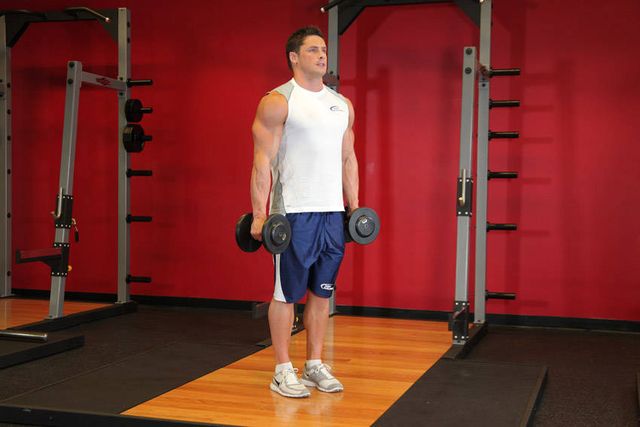
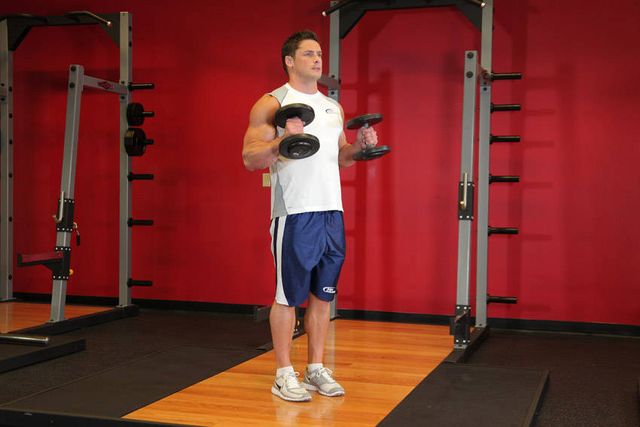
The only difference from the dumbbell biceps curl is the position of the forearm: palms facing each other, as when holding a hammer.
Muscles involved
Role
Muscle
Action in this movement
Main
Brachialis
Flexes the elbow; forearm position has no effect on it
Main
Brachioradialis
In the neutral forearm position it has its best length-tension position
Synergist
Biceps brachii
Flexes the elbow, but contributes less than in a regular curl
Stabilizer
Anterior deltoid and rotator cuff muscles
Keep the arm at the side of the body
Stabilizer
Trapezius and rhomboids
Keep the scapula fixed
Stabilizer
Forearm muscles
Grip the dumbbell and keep the wrist straight
Stabilizer
Core muscles
Prevent the trunk from swinging
Antagonist
Triceps brachii
Must relax
Origin and insertion of the target muscle
Muscle
Origin (fixed)
Insertion (moving)
Brachialis
Lower half of the front of the humerus
Radial tuberosity on the forearm
Brachioradialis
Lateral edge of the lower humerus
Lower end of the radius, near the wrist
Why the biceps contributes less
The biceps brachii has two jobs: flexing the elbow and supinating the forearm. When the forearm is in the neutral position, the biceps is not at its best mechanical advantage, and more load goes to the brachialis and brachioradialis. This exercise is a good example of how changing the grip changes the target muscle without changing the joint movement.
What must stay fixed
Upper arm: elbow at the side of the body.
Forearm: thumb points up throughout the movement; it does not rotate.
Wrists: in line with the forearm.
Torso: no swinging.
Phases and type of contraction
Phase
What happens
Contraction of the target muscles
Lifting
The elbow flexes
Concentric
Pause at the top
Dumbbell near the shoulder
Static
Lowering
The elbow extends with control
Eccentric
Execution
Stand straight, dumbbells at your sides, palms facing the thighs.
Without rotating the forearm, flex the elbow until the dumbbell is near the shoulder.
Pause for a moment.
Lower over two to three seconds.
Common faults
Fault
What happens in the body
Correction
Rotating the forearm at the top
The movement turns into a regular curl and the biceps takes over
Keep the thumb facing the ceiling
Swinging the trunk
The lower back and hips throw the weight up
Lighter weight
Elbow drifting forward
The anterior deltoid joins the movement
Elbow pinned to the side
Wrist bending toward the thumb side
Stress on the wrist; force is not transmitted properly