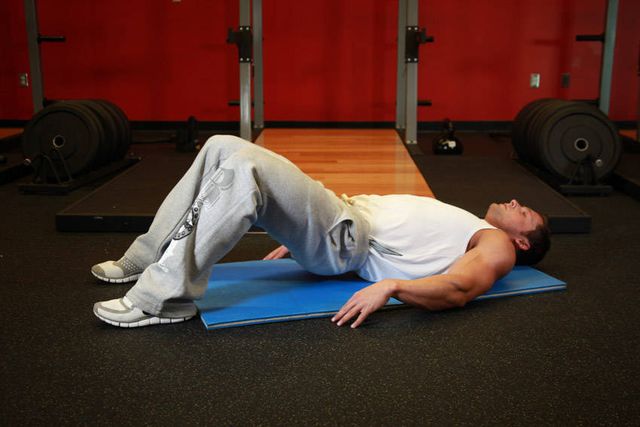
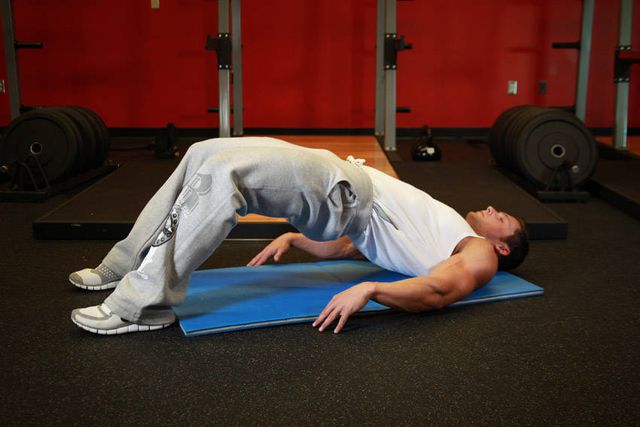
Body weight; later, a barbell or dumbbell on the hips
Type
Single-joint (hip)
Chain
Closed (feet and shoulders fixed on the floor)
Plane of movement
Sagittal
Target muscle
Gluteus maximus
Joint movements
Joint
Going up
Coming down
Pelvis
Extension
Flexion
Knee
Almost fixed in a bent position
Fixed
the spine
Fixed
Fixed
Muscles involved
Role
Muscle
Action in this movement
Main
Gluteus maximus
Extends the hip and lifts it
Synergist
Hamstrings
Assists hip extension
Stabilizer
Abdominal muscles
Keep the lower back from arching
Stabilizer
Erector spinae
Keeps the trunk straight
Stabilizer
Gluteus medius, adductors
Keep the knees aligned
Antagonist
Iliopsoas, rectus femoris
Hip flexors; must relax
Origin and insertion of the target muscle
Muscle
Upper head
Lower head
Gluteus maximus
Back of the pelvis, sacrum, and coccyx
Upper back of the femur and the iliotibial band
Why the knee is bent
The hamstrings also cross the knee. When the knee is bent, the hamstrings are shortened and produce less force. As a result, most of the work of hip extension falls to the gluteus maximus. If you place the feet farther away so the knee is straighter, the hamstrings contribute more.
What must stay fixed
Lower back: straight; the rise comes from the hips, not from arching the lower back.
Ribs: down.
Knees: hip-width apart; they do not fall inward or outward.
Feet: flat on the floor.
Phases and type of contraction
Phase
What happens
Gluteus maximus contraction
Going up
The hips rise until shoulders, hips, and knees are in one line
Concentric
Pause at the top
One to two seconds with the glutes tight
Static
Coming down
The hips return with control
Eccentric
Execution
Lie on your back; knees bent, feet flat on the floor, hip-width apart.
Arms at your sides on the floor.
Brace the abdomen and drive through the heels to lift the hips.
At the top, squeeze the glutes hard and pause.
Lower slowly.
Easier and harder
Level
Method
Harder
Longer pause at the top; single-leg; barbell on the hips
Next step
Hip thrust: the same movement with the shoulder blades on a bench, through a larger range of motion
Common faults
Fault
What happens in the body
Correction
Arching the lower back at the top
The erector spinae works in place of the gluteals and the vertebrae are compressed
Ribs down; a straight line is enough
Feeling the movement in the back of the thigh
The feet are too far from the hips and the hamstrings dominate
Bring the feet closer
Pressure on the toes
The quadriceps becomes more involved
Weight on the heels
Knees dropping inward
The gluteus medius is not working
Band around the knees
Coaching cue for the client
“Push with your heels and crack a walnut with your glutes at the top.”