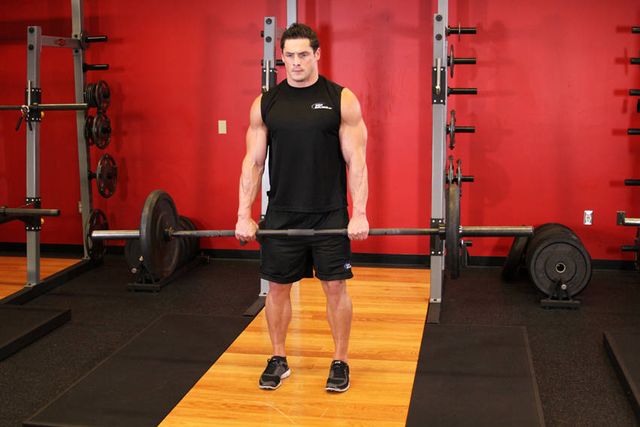
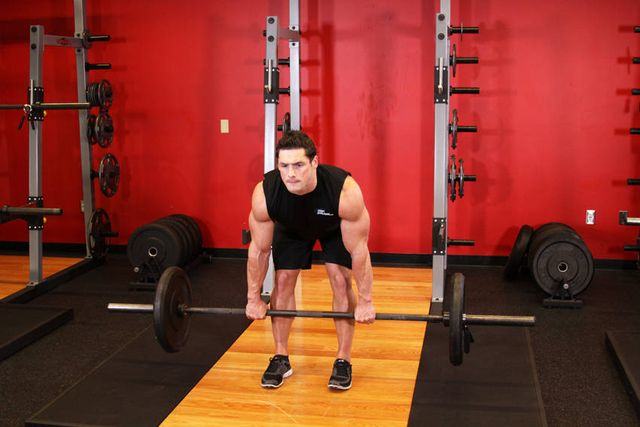
Difference from the squat: in the squat the knee bends a lot and the trunk stays relatively upright; here the knee is almost fixed and the trunk hinges forward at the hip.
Muscles involved
Role
Muscle
Action in this movement
Main
Hamstrings
Extends the hip
Main
Gluteus maximus
Extends the hip
Synergist
Adductor magnus
Assists hip extension
Stabilizer
Erector spinae
Keeps the back straight
Stabilizer
Latissimus dorsi
Keeps the bar close to the legs
Stabilizer
Trapezius, rhomboids
Do not let the shoulders fall forward
Stabilizer
Abdominal muscles
Brace the trunk
Stabilizer
Forearm muscles
Grip the bar
Antagonist
Iliopsoas, rectus femoris
Hip flexors
Origin and insertion of the target muscle
Muscle
Upper head
Lower head
Hamstrings
Ischial tuberosity of the pelvis
Top of the tibia and fibula, below the knee
Gluteus maximus
Back of the pelvis and sacrum
Upper back of the femur
The hamstrings stretch from the pelvis to below the knee. When the knee stays almost straight and the hip flexes, this muscle is stretched. That is why the client feels a stretch in the back of the thigh at the bottom of the movement; this is a sign of correct execution.
What must stay fixed
Lower back: straight from pelvis to neck.
Knees: slight bend, unchanged.
Bar: kept close to the thighs and shins.
Arms: straight; they only hold the weight.
Phases and type of contraction
Phase
What happens
Hamstring and gluteal contraction
Going down
Hips move back and the trunk tilts forward
Eccentric
Coming up
Hips move forward and the body straightens
Concentric
Execution
Stand tall with the bar in front of the thighs, knees slightly bent.
Push the hips back, as if closing a door behind you with your buttocks.
Lower the bar along your legs until you feel a stretch in the back of the thighs (usually to below the knee or mid-shin).
Drive the hips forward and stand tall; squeeze the glutes at the top.
Common faults
Fault
What happens in the body
Correction
Rounding of the lower back
The load shifts from the hamstrings to the lumbar ligaments and discs
Smaller range; practice the hip hinge with a dowel along the back
Too much knee bend
The movement turns into a squat and the hamstring stretch is lost