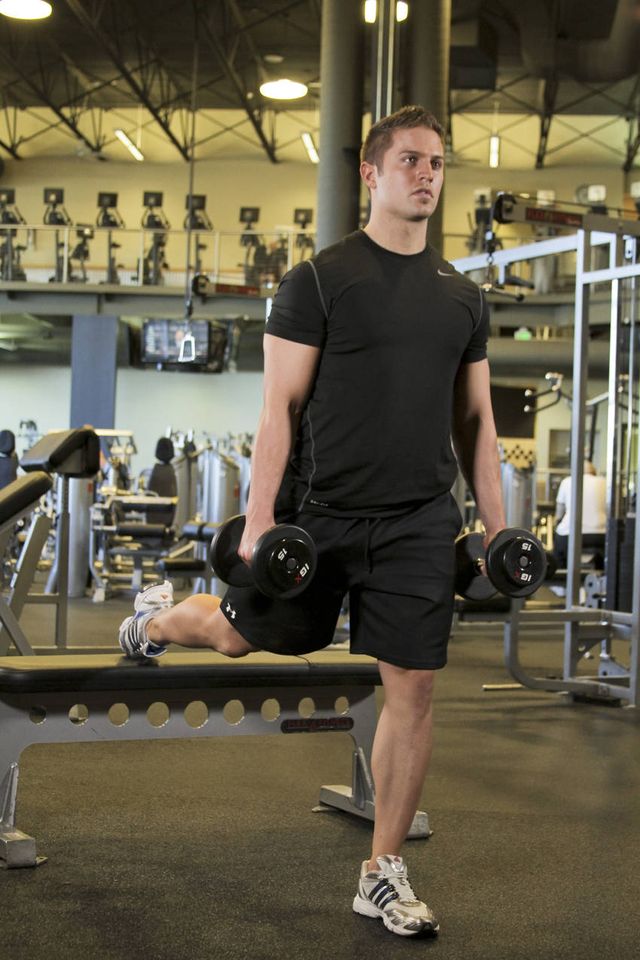
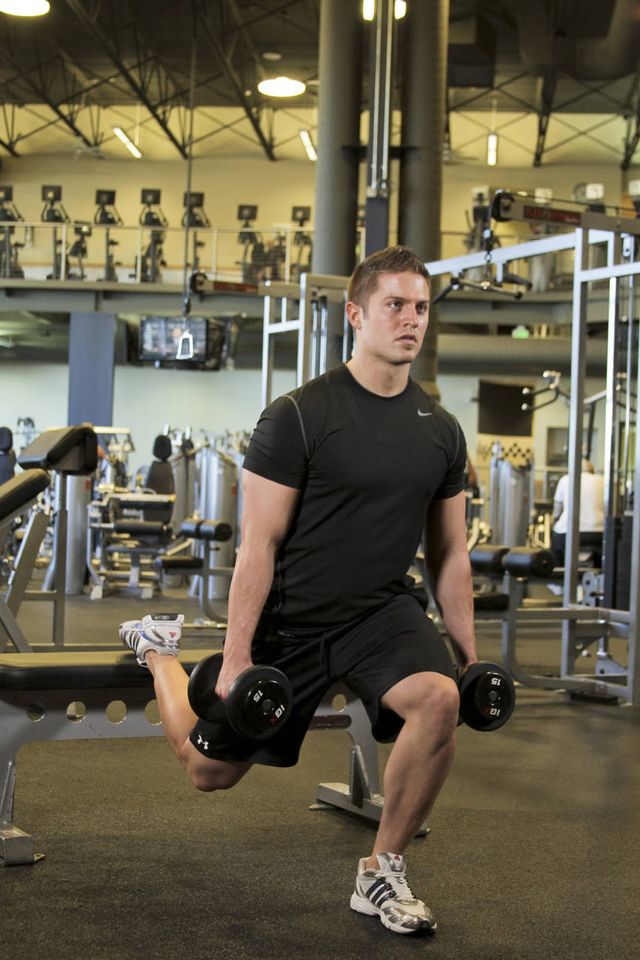
Back leg: the knee flexes and the hip stays extended; it mainly serves for balance.
Muscles involved
Role
Muscle
Action in this movement
Main
Quadriceps (front leg)
Extends the knee
Main
Gluteus maximus (front leg)
Extends the hip
Synergist
Hamstrings, adductor magnus
Assist hip extension
Synergist
Back-leg quadriceps
Assists in rising
Stabilizer
Gluteus medius and minimus
Keep the pelvis level and prevent the knee from collapsing inward
Stabilizer
Core muscles, erector spinae
Keep the trunk upright
Stabilizer
Calf and foot muscles
Maintain balance
Antagonist
Iliopsoas (front leg)
Hip flexor
Difference from the squat
The main muscles are the same, but the base of support is narrow. So the pelvic stabilizers, especially gluteus medius, work harder. Also, each leg works separately, so strength differences between the two sides become visible.
What must stay fixed
Torso: upright or leaning slightly forward.
Pelvis: level; one side does not drop.
Front knee: in line with the toes.
Front heel: on the floor.
Phases and type of contraction
Phase
What happens
Contraction of the front-leg quadriceps and gluteus maximus
Going down
Back knee approaches the floor
Eccentric
Coming up
Body rises
Concentric
Execution (stationary lunge)
One foot forward, one back; the side-to-side distance between the feet is hip width.
Go straight down until the back knee is near the floor.
Both knees at about 90 degrees.
Push through the front heel to rise.
Finish the repetitions, then switch legs.
Common faults
Fault
What happens in the body
Correction
Front knee collapsing inward
Gluteus medius is not controlling the pelvis; stress on the inside of the knee
Keep the knee pointing toward the second toe
Stride too short
The heel lifts and stress on the front of the knee increases
Longer stride
Feet on one line
The base of support becomes too narrow and balance is difficult
Feet hip-width apart, like train tracks
Trunk folding over the thigh
The lower back takes more load
Chest up
Pushing off with the back leg
Load is taken off the front leg
Weight on the front heel
Coaching cue for the client
“Go up and down like an elevator, not forward like an escalator.”