Muscles involved, shown on the body
Body map: body-muscles (Apache-2.0) · Sources
At a glance
| Equipment | Body weight, dumbbell (goblet) or barbell |
| Type | Multi-joint |
| Chain | Closed (the feet are fixed on the floor) |
| Plane of movement | Sagittal |
| Target muscle | Quadriceps, gluteus maximus |
Joint movements
| Joint | Going down | Coming up |
|---|
| Pelvis | Flexion | Extension |
| Knee | Flexion | Extension |
| Ankle | Dorsiflexion | Plantarflexion |
| the spine | Fixed | Fixed |
Muscles involved
| Role | Muscle | Action in this movement |
|---|
| Main | Quadriceps | Extends the knee |
| Main | Gluteus maximus | Extends the hip |
| Synergist | Adductor magnus | Assists hip extension |
| Synergist | Hamstrings | Assists hip extension and keeps the knee stable |
| Synergist | Soleus | Controls the shin |
| Stabilizer | Erector spinae | Keeps the back straight |
| Stabilizer | Abdominal muscles | Brace the trunk |
| Stabilizer | Gluteus medius and minimus | Do not let the knee fall inward |
| Antagonist | Iliopsoas | Hip flexor; must relax during the ascent |
Origin and insertion of the target muscle
| Muscle | Upper head | Lower head |
|---|
| Quadriceps | Pelvis and femur | Tibial tuberosity, via the patella |
| Gluteus maximus | Back of the pelvis and sacrum | Upper back of the femur |
Because the foot is fixed on the floor, the distal end stays fixed and the body moves up and down over the feet.
What must stay fixed
- Lower back: straight; the natural curve is maintained.
- Feet: flat on the floor; the heels do not lift.
- Knees: in line with the toes.
Phases and type of contraction
| Phase | What happens | Contraction of the quadriceps and gluteals |
|---|
| Going down | Hips move back and down | Eccentric |
| Coming up | Body straightens | Concentric |
Execution
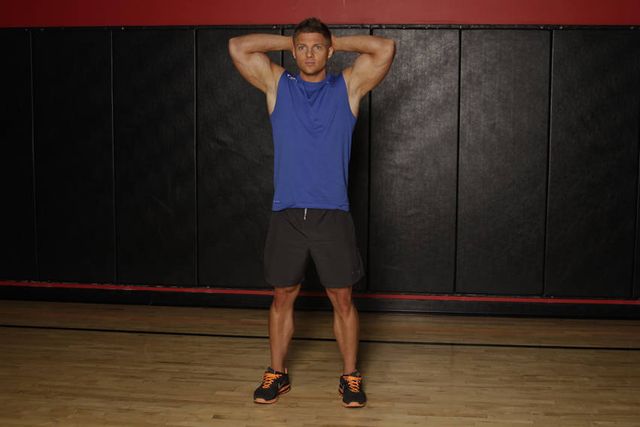
- Feet slightly wider than hip width, toes turned slightly outward.
- Take a breath and tighten your abdominals.
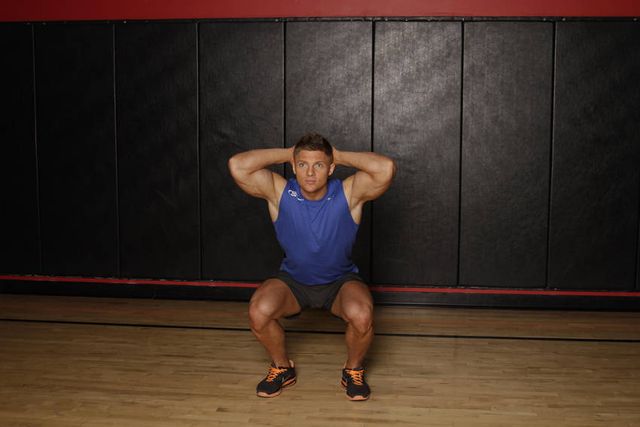
- Flex the hips and knees at the same time, as if sitting on a chair.
- Go down as far as the back stays straight; ideally the thighs parallel to the floor or lower.
- Push the floor away and rise.
Progression order
| Stage | Exercise |
|---|
| 1 | Sitting down on and standing up from a chair |
| 2 | Body-weight squat |
| 3 | Goblet squat (dumbbell in front of the chest) |
| 4 | Barbell squat |
Common faults
| Fault | What happens in the body | Correction |
|---|
| Knees falling inward | Gluteus medius is not controlling the pelvis and thigh; stress on the medial ligaments of the knee | “Push your knees out”; band around the knees |
| Heels lifting | Ankle range of motion is limited; the load goes to the front of the knee | Small plate under the heels; work on ankle mobility |
| Lower back rounding at the bottom | The load is transferred to the lumbar discs | Less depth; brace the abdominals |
| Trunk leaning too far forward | The movement starts to resemble a hip hinge and the lower back takes more load | Goblet version; chest up |
| Hips rising before the chest | The knees straighten first and the lower back does the rest of the work | Hips and chest should rise together |
The knee traveling past the toes is not a fault in itself, provided the heel stays on the floor.
Coaching cue for the client
“Sit down between your feet and push the floor away with your soles.”
← All exercises