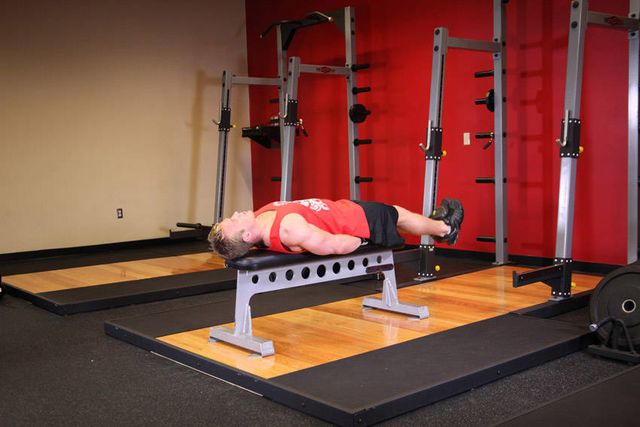
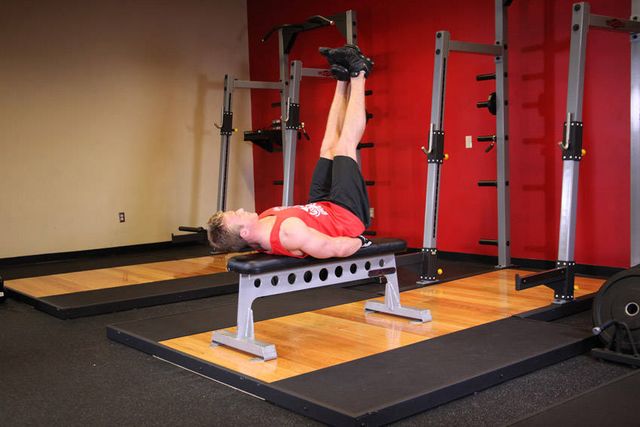
Many people consider this exercise a “lower abs workout,” but the joint that moves is the hip, not the spine. So the muscle that raises the legs is a hip flexor. The abdominal muscles do not create movement; their job is to keep the lower back from lifting off the floor.
Muscles involved
Role
Muscle
Action in this movement
Main
Iliopsoas
Raises the thigh
Synergist
Rectus femoris (of the quadriceps)
Assists hip flexion and keeps the knee straight
Stabilizer
Rectus abdominis
Fix the pelvis so the lower back does not arch
Stabilizer
Obliques, transversus abdominis
Tighten around the trunk
Antagonist
Gluteus maximus, hamstrings
Must relax
Origin and insertion of the target muscle
Muscle
Origin (fixed)
Insertion (moving)
Iliopsoas
Lumbar vertebrae and the inner surface of the pelvis
Lesser trochanter of the femur
The origin of this muscle is on the lumbar vertebrae. As the legs lower and the load increases, this same muscle pulls the vertebrae forward. If the abdominals are not strong enough, the lower back lifts off the floor. In practice, this exercise tests the abdominals' ability to hold the pelvis stable.
What must stay fixed
Lower back: pressed against the floor throughout the movement.
Knees: at a fixed angle.
Head and shoulders: on the floor.
Phases and type of contraction
Phase
What happens
Hip flexors
Abdominal muscles
Lifting
Legs rise to vertical
Concentric
Static
Lowering
Legs lower under control
Eccentric
Isometric, with the greatest demand close to the floor
Execution
Lie on your back; arms beside the body or under the hips.
Press your lower back into the floor and tighten your abdominals.
Raise both legs together to vertical.
Lower slowly and stop just before the lower back lifts off the floor.
Easier and harder
Level
Method
Easier
Knees bent; or one leg at a time
Harder
Legs fully straight; lowering the legs further; hanging from a bar
Common faults
Fault
What happens in the body
Correction
Lower back leaving the floor
Iliopsoas pulls on the vertebrae and the abdominals are not in control; stress on the lower back
Smaller range; knees bent
Dropping the legs
The eccentric phase is skipped
Three seconds down
Swinging and throwing the legs
Momentum does the work
Slow movement
Lifting the head and pulling on the neck
Stress on the neck
Head on the floor
Coaching cue for the client
“Keep your lower back on the floor; wherever it lifts, stop right there.”