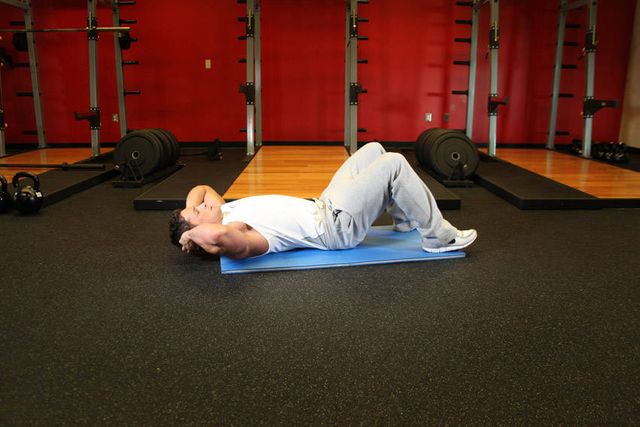
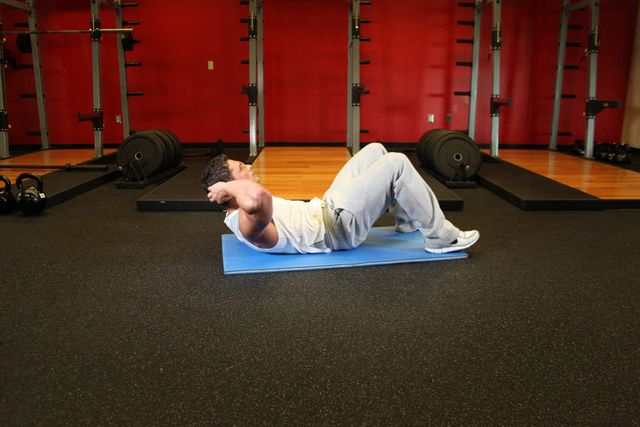
These three exercises show three different roles of a single muscle.
Muscles involved
Role
Muscle
Action in this movement
Main
Rectus abdominis
Brings the rib cage toward the pelvis
Synergist
External and internal obliques
Assist trunk flexion
Stabilizer
Iliopsoas
Holds the pelvis fixed
Stabilizer
Muscles at the front of the neck
Keep the head in line with the trunk
Antagonist
Erector spinae
Must relax
Origin and insertion of the target muscle
Muscle
Lower head (fixed)
Upper head (moving)
Rectus abdominis
Pubic bone
Costal cartilages of ribs 5 to 7 and the xiphoid process
This muscle connects the pelvis to the rib cage and does not cross the hip joint. So the only thing it can do is bring the ribs and pelvis closer together, that is, flex the spine.
Why a full sit-up is not needed
Beyond about 30 degrees, the rest of the rise comes from the hip joint, and the hip flexors do the work, not the abdominals. Sitting all the way up puts extra load on the lumbar vertebrae without engaging the abdominals any more.
What must stay fixed
Lower back: on the floor.
Pelvis and legs: still.
Neck: keep the chin-to-chest distance constant, about one fist.
Phases and type of contraction
Phase
What happens
Rectus abdominis contraction
Coming up
The shoulder blades lift off the floor
Concentric
Pause at the top
A moment
Static
Going down
The trunk returns to the floor with control
Eccentric
Execution
Lie on your back; knees bent, feet flat on the floor.
Hands on the chest or fingertips beside the ears.
As you exhale, curl the ribs toward the pelvis until the shoulder blades lift off the floor.
Pause for a moment.
Lower slowly, without letting the head rest on the floor.
Common faults
Fault
What happens in the body
Correction
Pulling the head with the hands
The cervical vertebrae come under strain
Hands on the chest
Coming all the way up
The hip flexors take over and the lower back is strained
Only until the shoulder blades lift off
Throwing the trunk up
Momentum does the work
Slow movement with a pause
Holding the breath
Intra-abdominal pressure rises
Exhale as you come up
Feet lifting off the floor
The hip flexors are overly involved
Smaller range of motion
Safety
Repeated spinal flexion is not suitable for a client with a history of lumbar disc problems. Use a plank for them instead.
Coaching cue for the client
“Curl your ribs toward your navel; don't let your lower back come off the floor.”