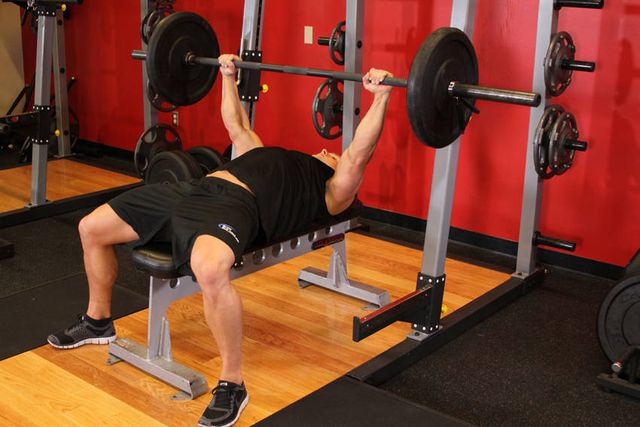
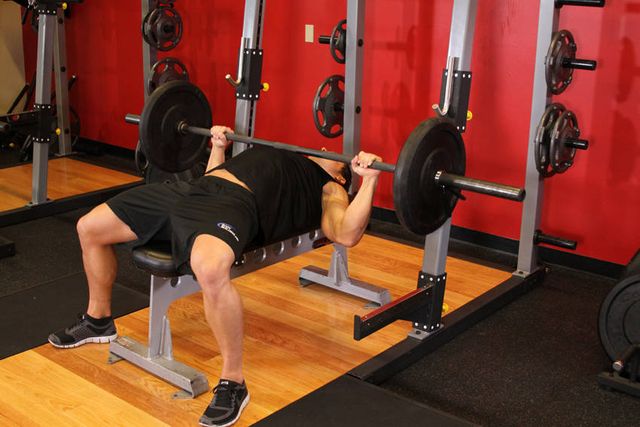
Muscles involved, shown on the body
Body map: body-muscles (Apache-2.0) · Sources
At a glance
| Equipment | Barbell and flat bench |
| Type | Multi-joint |
| Chain | Open |
| Plane of movement | Transverse (with some sagittal) |
| Target muscle | Pectoralis major |
Joint movements
| Joint | Going up (pressing) | Returning (lowering) |
|---|
| Shoulder | Horizontal adduction | Horizontal abduction |
| Elbow | Extension | Flexion |
| Scapula | Fixed: retracted and depressed | Fixed |
| Wrist, spine | Fixed | Fixed |
Muscles involved
| Role | Muscle | Action in this movement |
|---|
| Main | Pectoralis major | Brings the arm toward the front of the chest |
| Synergist | Anterior deltoid | Assists shoulder movement |
| Synergist | Triceps brachii | Extends the elbow |
| Stabilizer | Rotator cuff muscles | Hold the head of the humerus in the glenoid cavity |
| Stabilizer | Middle and lower trapezius, rhomboids | Lock the scapulae back and down against the bench |
| Stabilizer | Core muscles, gluteals, legs | Hold the body firmly on the bench |
| Antagonist | Posterior deltoid, latissimus dorsi, biceps brachii | Control the path of the bar during lowering |
Origin and insertion of the target muscle
| Muscle | Origin (fixed) | Insertion (moving) |
|---|
| Pectoralis major | Clavicle, sternum, and costal cartilages | Upper humerus |
The origin is on the rib cage and stays fixed; the humerus is pulled toward it.
What must stay fixed
- Shoulder blades: drawn together and down, pressed against the bench throughout the movement.
- Wrists: straight and directly above the elbows.
- Hips and head: on the bench.
- Feet: flat on the floor.
Phases and type of contraction
| Phase | What happens | Pectoralis major contraction |
|---|
| Lowering | The bar descends to the chest | Eccentric |
| Pressing up | The bar rises until the elbows are straight | Concentric |
Execution
- Lie on the bench; eyes under the bar.
- Draw the scapulae together and down.
- Grip the bar slightly wider than shoulder width and unrack it.
- Lower the bar with control to mid-chest; elbows at about 45 to 70 degrees from the trunk.
- Press the bar up until the elbows are straight.
Common faults
| Fault | What happens in the body | Correction |
|---|
| Elbows flaring out to 90 degrees from the trunk | Stress on the front of the shoulder joint increases | Bring the elbows slightly closer to the trunk |
| Shoulders rolling forward at the top | The scapulae lift off the bench and shoulder stability is lost | Keep the scapulae locked |
| Bouncing the bar off the chest | The eccentric phase is skipped; risk of rib cage injury | Lower slowly |
| Hips lifting off the bench | The lower back arches excessively and the range of motion shortens | Hips on the bench; use a lighter weight |
| Wrists bending backward | Force is not transmitted properly and the wrists are stressed | Place the bar over the heel of the palm |
Safety
With heavy weights, always use a spotter or safety pins.
Coaching cue for the client
“Put your shoulder blades in your back pockets and keep them there.”
← All exercises