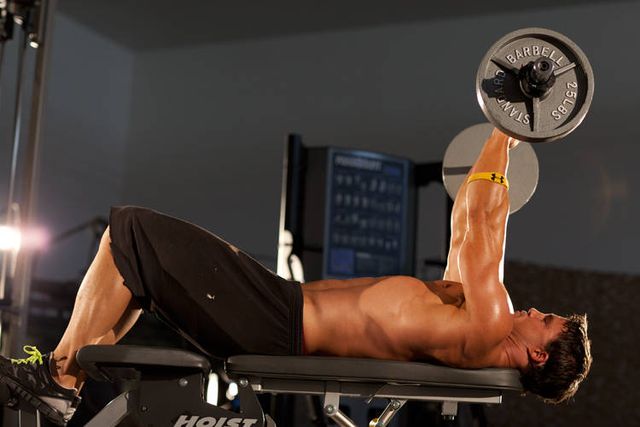
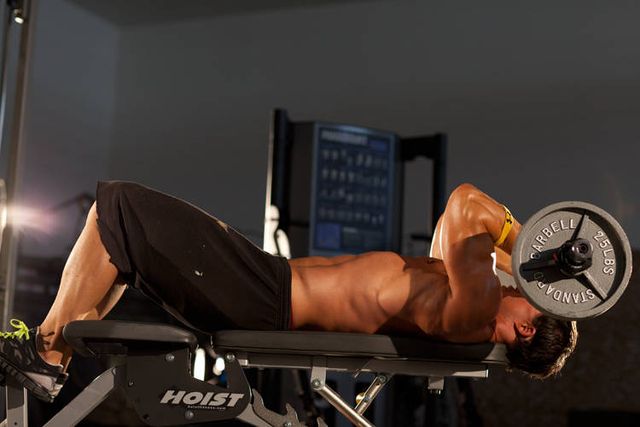
Fixed; upper arm perpendicular to the floor or tilted slightly toward the head
Fixed
Wrist, scapula, spine
Fixed
Fixed
Muscles involved
Role
Muscle
Action in this movement
Main
Triceps brachii (all three heads)
Extends the elbow
Stabilizer
Deltoid, latissimus dorsi, pectoralis major
Hold the upper arm still above the shoulder
Stabilizer
Rotator cuff muscles
Keep the shoulder joint stable
Stabilizer
Forearm muscles
Grip the bar and keep the wrist straight
Antagonist
Biceps brachii, brachialis
Must relax to allow the elbow to extend
Origin and insertion of the target muscle
Head
Origin (fixed)
Insertion (moving)
Long head
Scapula, below the glenoid cavity
Olecranon of the ulna
Lateral and medial heads
Back of the humerus
Olecranon of the ulna
Difference from the cable triceps pushdown
In the cable triceps pushdown the arm is at the side of the body. Here the arm is raised overhead and the long head of the triceps, which originates on the scapula, is stretched more. For this reason this exercise trains the long head in a more lengthened position.
What must stay fixed
Upper arm: still from shoulder to elbow; only the forearm moves.
Elbows: shoulder-width apart; they do not flare outward.
Wrists: straight.
Lower back and head: on the bench.
Phases and type of contraction
Phase
What happens
Triceps contraction
Lowering
Bar moves toward the forehead or behind the head
Eccentric
Pressing up
The elbows straighten
Concentric
Execution
Lie on the bench; hold the bar above your chest with a shoulder-width grip.
Fix your upper arms perpendicular to the floor or tilted slightly toward the head.
Bend only the elbows to lower the bar slowly to near your forehead.
Extend the elbows until the arms are straight.
Common faults
Fault
What happens in the body
Correction
Elbows flaring outward
The shoulder rotates inward and stress on the elbow increases
Elbows pointing at the ceiling and parallel
Moving the upper arm along with the forearm
The movement starts to resemble a pullover and latissimus dorsi assists
Upper arm fixed
Lowering too fast
The bar is not controlled and jolts the elbow
Three seconds down
Heavy weight
Heavy stress on the elbow tendon
Lighter weight with full range of motion
Safety
The bar moves directly above the face. Work with a weight that you can fully control and use a spotter on heavy sets.
Coaching cue for the client
“Your upper arm is a pillar; only your forearm opens and closes like a door.”