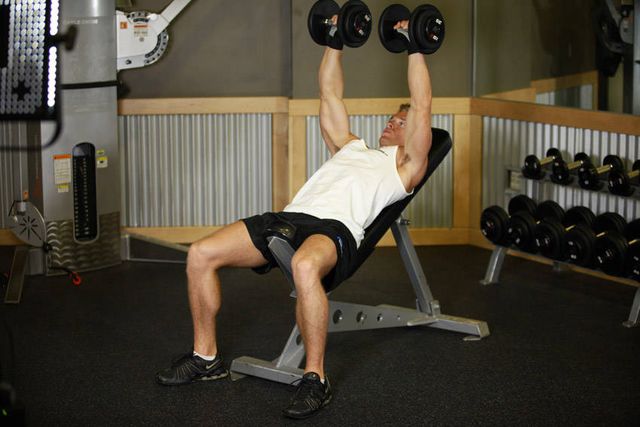
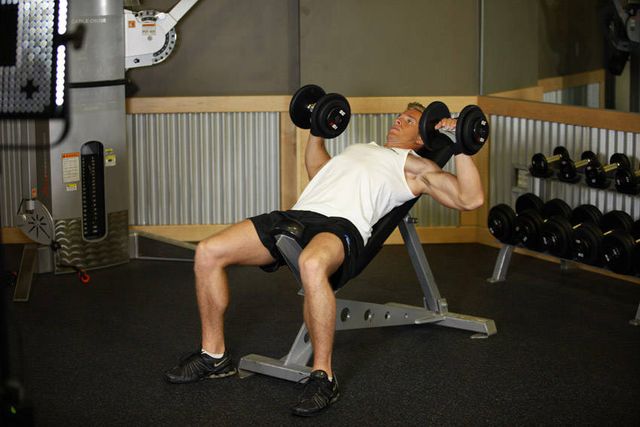
A pair of dumbbells, incline bench (30 to 45 degrees)
Type
Multi-joint
Chain
Open
Plane of movement
Between transverse and sagittal
Target muscle
Pectoralis major (clavicular part)
Joint movements
Joint
On lowering
On pressing up
Shoulder
Horizontal abduction with extension
Horizontal adduction with flexion
Elbow
Flexion
Extension
Scapula
Fixed: retracted and depressed
Fixed
Wrist, spine
Fixed
Fixed
Difference from the flat bench press
In the bench press, the arm moves perpendicular to the torso. Inclining the bench makes the path of the hands upward relative to the torso. That is, some shoulder flexion is added to the horizontal adduction; this is exactly the job of the clavicular head of the pectoralis and the anterior deltoid.
Bench angle
Dominant muscle
Flat
Pectoralis major, sternal part
30 to 45 degrees
Pectoralis major, clavicular part
More than 60 degrees
Anterior deltoid; the movement approaches a shoulder press
The fibers of this part run downward and outward from the clavicle. When the arm moves forward and upward, the movement path lines up with the direction of these fibers.
Dumbbell or barbell
With dumbbells each arm works independently. So the stabilizers are more involved, the range of motion is greater, and strength differences between the two sides show up. In return, less weight can be lifted.
What must stay fixed
Shoulder blades: back and down, pressed against the backrest.
Wrists: straight and above the elbows.
Hips and head: on the bench.
Feet: flat on the floor.
Phases and type of contraction
Phase
What happens
Pectoralis major contraction
Lowering
The dumbbells lower to the side of the upper chest
Eccentric
Pressing up
The dumbbells rise until the elbows are straight
Concentric
Execution
Set the bench to 30 to 45 degrees and sit; dumbbells on the thighs.
Using your thighs to help, bring the dumbbells up to the sides of the shoulders and lean back.
Lock the scapulae back and down.
Press the dumbbells straight up until the elbows are straight.
Lower with control until the dumbbells reach the side of the upper chest; elbows about 45 to 60 degrees from the trunk.
Common faults
Fault
What happens in the body
Correction
Bench angle too steep
The anterior deltoid takes over the main work
30 to 45 degree incline
Excessive lower back arch
The trunk angle flattens and the effect of the incline is lost
Hips and shoulder blades on the bench
Clanging the dumbbells together at the top
Muscle tension is released and control is lost
Dumbbells stay above the shoulders
Shoulders rolling forward
The scapulae lift off the backrest
Scapulae locked
Going too low
Stress on the front of the shoulder capsule
Down to chest level
Coaching cue for the client
“Push the dumbbell straight toward the ceiling, not toward your face.”