Muscles involved, shown on the body
Body map: body-muscles (Apache-2.0) · Sources
At a glance
| Equipment | Barbell |
| Type | Multi-joint |
| Chain | Open |
| Plane of movement | Sagittal |
| Target muscle | Latissimus dorsi, middle trapezius, rhomboids |
Joint movements
| Joint | Going up (pulling) | Returning (lowering) |
|---|
| Shoulder | Extension | Flexion |
| Elbow | Flexion | Extension |
| Scapula | Retraction | Protraction |
| Hip, knee, spine | Fixed in the bent-over position | Fixed |
Muscles involved
| Role | Muscle | Action in this movement |
|---|
| Main | Latissimus dorsi, teres major | Pull the arm backward |
| Main | Middle trapezius, rhomboids | Draw the scapulae together |
| Synergist | Posterior deltoid | Assists in moving the arm backward |
| Synergist | Biceps brachii, brachialis, brachioradialis | Flex the elbow |
| Stabilizer | Erector spinae | Keeps the back straight |
| Stabilizer | Gluteus maximus, hamstrings | Hold the hips in the hinged position |
| Stabilizer | Core muscles | Keep the trunk braced |
| Stabilizer | Forearm muscles | Grip the bar |
| Antagonist | Pectoralis major, anterior deltoid, triceps brachii | Must relax |
Origin and insertion of the target muscle
| Muscle | Origin (fixed) | Insertion (moving) |
|---|
| Latissimus dorsi | Vertebrae, thoracolumbar fascia, iliac crest | Upper humerus |
| Rhomboids and middle trapezius | Spinous processes of the vertebrae | Scapula |
Both muscle groups originate from the spine. So if the lower back rounds, the base of these muscles loosens.
What must stay fixed
- Lower back: straight from pelvis to neck.
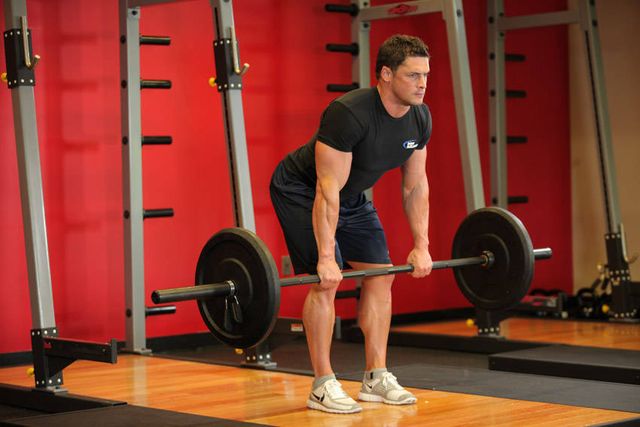
- Torso angle: about 30 to 45 degrees relative to the floor; it does not change during the set.
- Knees: slightly bent and still.
This movement demands two things at once: holding the hip hinge isometrically and pulling with the arms.
Phases and type of contraction
| Phase | What happens | Contraction of the target muscles |
|---|
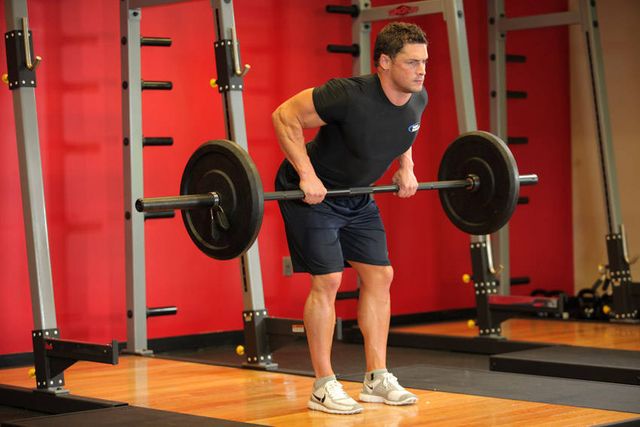
| Pulling | The bar comes toward the lower abdomen | Concentric |
| Lowering | The arms straighten with control | Eccentric |
The erector spinae, gluteals, and hamstrings contract isometrically throughout.
Execution
- Grip the bar, bend the knees slightly, and hinge forward at the hips; back straight.
- Arms hanging straight, bar under the shoulders.
- Pull the elbows back until the bar reaches the lower abdomen; draw the scapulae together.
- Lower with control.
Common faults
| Fault | What happens in the body | Correction |
|---|
| Rounding of the lower back | The load shifts from the muscles to the ligaments and discs of the lower back | Use a lighter weight; practice the hip hinge first |
| Trunk rising with each rep | The hips and lower back lift the weight, not the back muscles | Keep the trunk angle fixed |
| Pulling toward the chest with the elbows flared | The contribution of the upper trapezius and posterior deltoid increases | Pull the bar toward the navel |
| Scapulae not coming together | Only the arms are working | Pause briefly at the top with the scapulae retracted |
Alternative for beginners
If the client cannot keep the back straight, use a single-arm dumbbell row supported on a bench, or a machine seated row.
Coaching cue for the client
“Your back is a tabletop; pull your elbows to the ceiling.”
← All exercises