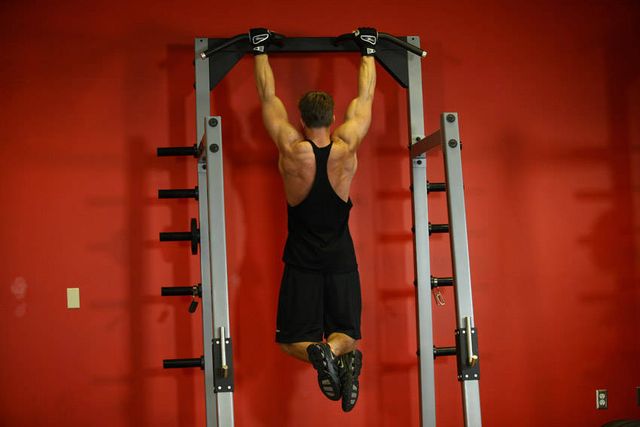
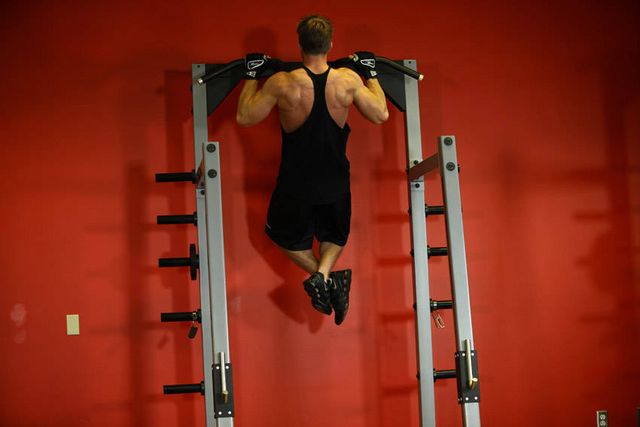
The joint movement is exactly the same as the lat pulldown. The difference is that there the bar comes toward the body, while here the body goes toward the bar.
Muscles involved
Role
Muscle
Action in this movement
Main
Latissimus dorsi
Pulls the trunk up toward the upper arm
Main
Teres major
The same action as the latissimus dorsi
Synergist
Biceps brachii, brachialis, brachioradialis
Flex the elbow
Synergist
Middle and lower trapezius, rhomboids
Pull the scapula down and back
Synergist
Posterior deltoid
Assists shoulder movement
Stabilizer
Forearm muscles
Hold the body hanging from the bar
Stabilizer
Abdominal muscles, gluteals
Prevent the body from swinging
Antagonist
Middle deltoid, triceps brachii
Must relax
Origin and insertion of the target muscle
Muscle
Head on the trunk
The attachment on the arm
Latissimus dorsi
Lower thoracic and lumbar vertebrae, thoracolumbar fascia, iliac crest
Upper humerus
This exercise is a clear example of origin and insertion swapping roles: the arm stays fixed and the end on the trunk, that is, the whole body, is pulled toward it.
Hand position
Grip
Common name
Effect
Palms facing forward
Pull-up
Less biceps contribution
Palms facing you
Chin-up
More biceps contribution; usually easier
What must stay fixed
Torso and legs: no swinging.
Ribs: down; the lower back does not arch excessively.
Neck: the chin is not thrust forward to reach the bar.
Phases and type of contraction
Phase
What happens
Latissimus dorsi contraction
Going up
Chin reaches above the bar
Concentric
Coming down
The arms straighten with control
Eccentric
Execution
Grip the bar slightly wider than shoulder width and hang.
First move the shoulders away from the ears (scapulae down).
Pull the elbows down and toward your sides until the chin passes the bar.
Lower over two to three seconds until the arms are straight.
Progression order
Stage
Exercise
1
Hanging and only pulling the scapulae down
2
Negative pull-up: jump up and lower slowly
3
Pull-up with a band or assisted machine
4
Full pull-up
Common faults
Fault
What happens in the body
Correction
Swinging the body and kicking
Momentum lifts the body, not latissimus dorsi
Abdominals and glutes tight; assisted version
Incomplete range at the bottom
The muscle does not work in its lengthened position
Lower until the arms are straight
Shoulder staying up by the ear
Upper trapezius and shoulder ligaments take the load
Start the movement with the scapula
Pushing the chin forward
Stress on the neck
Take the chest toward the bar
Coaching cue for the client
“Pull the bar down to your chest, don't pull yourself up.”