Kalbodyar Coach assistant Exercises Seated cable row Muscles involved, shown on the body
Body map: body-muscles (Apache-2.0) · Sources
At a glance
Equipment Low cable machine with a double handle Type Multi-joint Chain Open Plane of movement Sagittal Target muscle Latissimus dorsi, middle trapezius, rhomboids
Joint movements
Joint Going up (pulling) On the way back Shoulder Extension Flexion Elbow Flexion Extension Scapula Retraction Protraction Spine, pelvis, knee Fixed Fixed
This is the same pattern as the bent-over barbell row , except that the body is seated and the lower back bears less load. That is why this exercise is a better starting point for a beginner.
Muscles involved
Role Muscle Action in this movement Main Latissimus dorsi, teres major Pull the arm backward Main Middle trapezius, rhomboids Draw the scapulae together Synergist Posterior deltoid Assists in moving the arm backward Synergist Biceps brachii, brachialis, brachioradialis Flex the elbow Stabilizer Erector spinae Keeps the trunk straight Stabilizer Abdominal muscles Do not let the trunk fall backward Stabilizer Forearm muscles Grip the handle Antagonist Pectoralis major, anterior deltoid, triceps brachii Must relax
Origin and insertion of the target muscle
Muscle Origin (fixed) Insertion (moving) Latissimus dorsi Vertebrae, thoracolumbar fascia, iliac crest Upper humerus Rhomboids and middle trapezius Spinous processes of the vertebrae Scapula
What must stay fixed
Torso: straight and upright; it does not move forward and back.Knees: slightly bent and still.Shoulders: down, away from the ears.Phases and type of contraction
Phase What happens Contraction of the target muscles Pulling The handle comes toward the abdomen and the scapulae retract Concentric Pause A moment with the scapulae squeezed together Static Return The arms straighten under control and the scapulae protract Eccentric
Execution
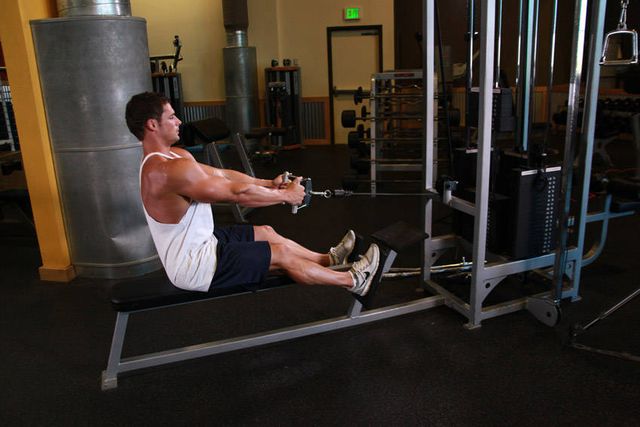
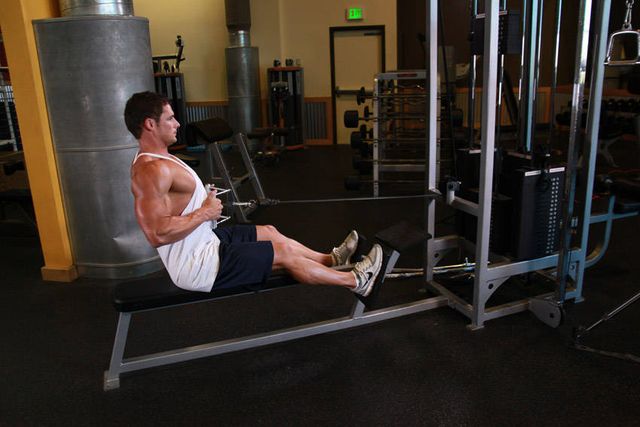
Sit with your feet on the plate, knees slightly bent. Grip the handle and sit with a straight trunk. Pull the elbows back along your sides until the handle reaches the abdomen. Squeeze the scapulae together and pause for a moment. Return under control and let the scapulae move forward, without the lower back rounding. Common faults
Fault What happens in the body Correction Trunk rocking back and forth The hips and lower back pull the weight, not the back muscles Keep the trunk fixed; use a lighter weight Lower back rounding on the return The load goes to the lumbar discs and ligaments Only the scapula should move forward, not the lower back Shoulders rising The upper trapezius takes over Shoulders down Pulling with the arms only The biceps tire early and the scapulae do not retract Lead the movement with the elbows
Coaching cue for the client
“Elbows back, chest forward.”
← All exercises