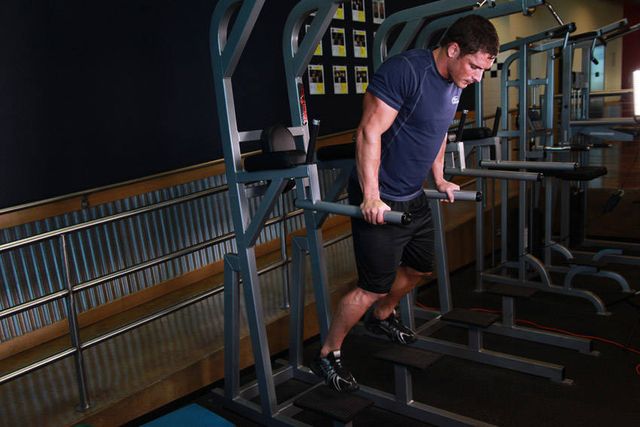
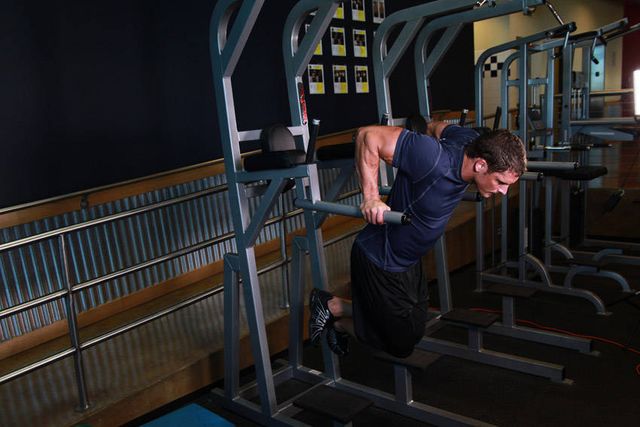
Keep the scapula down so the body does not sink between the shoulders
Stabilizer
Rotator cuff muscles
Hold the head of the humerus in the socket
Stabilizer
Core muscles
Prevent the body from swinging
Antagonist
Biceps brachii, posterior deltoid
Must relax
Origin and insertion of the target muscle
The hands are fixed on the bars, so the roles are reversed: the upper arm and forearm stay fixed while the torso moves up and down.
Muscle
Head on the trunk
Head on the limb
Pectoralis major
Sternum and costal cartilages
Upper humerus
Triceps brachii
Scapula and back of the humerus
Olecranon of the ulna
Upright or leaning trunk
Trunk position
Dominant muscle
Leaning forward, elbows slightly flared
Pectoralis major
Upright, elbows close to the body
Triceps brachii
What must stay fixed
Shoulder blades: down; the shoulders do not rise toward the ears.
Torso: constant angle throughout the movement.
Legs: no swinging.
Phases and type of contraction
Phase
What happens
Chest and triceps contraction
Going down
The elbows bend and the body descends
Eccentric
Coming up
The elbows straighten
Concentric
Execution
Grip the bars and hold yourself up with straight arms; shoulders down.
Lean slightly forward and bend the knees.
Lower slowly until the upper arm is almost parallel to the floor.
Push through the bars and rise until the elbows are straight.
Easier and harder
Level
Method
Easier
Assisted dip machine; band under the knees; lowering phase only
Harder
Weight on a belt
Common faults
Fault
What happens in the body
Correction
Going too low
The head of the humerus slides forward and stresses the front of the shoulder capsule
Until the upper arm is parallel to the floor
Shoulders rising
The body hangs on the shoulder ligaments
Move the shoulders away from the ears
Elbows flaring out too much
Stress on the shoulder increases
Elbows at most 45 degrees from the trunk
Swinging the legs
Momentum does the work instead of the muscle
Abdomen braced; slow movement
Safety
This exercise puts the shoulder in a high-stress position. It is not suitable for a client with shoulder pain or a history of shoulder injury; use a push-up instead.
Coaching cue for the client
“Shoulders away from your ears; down gently, up strongly.”