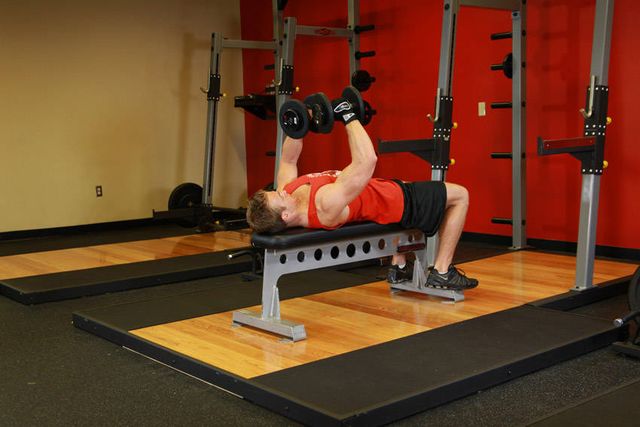
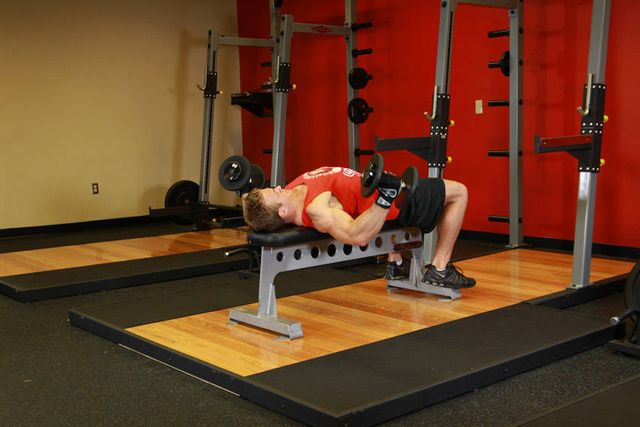
In the bench press, the shoulder and elbow move together and the triceps brachii does a large share of the work. Here the elbow is fixed, so the triceps is almost eliminated and only horizontal adduction of the shoulder remains, which is the main job of the pectoralis major.
Muscles involved
Role
Muscle
Action in this movement
Main
Pectoralis major
Brings the arms from both sides to above the chest
Synergist
Anterior deltoid
Assists horizontal adduction
Stabilizer
Biceps brachii, brachialis
Hold the elbow at a fixed bend
Stabilizer
Forearm muscles
Grip the dumbbell and keep the wrist straight
Stabilizer
Rotator cuff muscles
Hold the head of the humerus in the socket
Stabilizer
Middle trapezius, rhomboids
Lock the scapulae against the bench
Antagonist
Posterior deltoid, middle trapezius
Produce the opposite movement
Origin and insertion of the target muscle
Muscle
Origin (fixed)
Insertion (moving)
Pectoralis major
Clavicle, sternum, and costal cartilages
Upper humerus
When the arms open out, the insertion moves away from the origin and the muscle is stretched under load. The greatest stress on the muscle occurs in this open position.
Why the weight must be light
The dumbbell sits at the end of an almost straight arm, far from the shoulder joint. At the bottom of the movement, this moment arm reaches its maximum. A weight that feels light in a press feels heavy here.
What must stay fixed
Elbows: slight bend, unchanged throughout the movement.
Shoulder blades: back and down.
Wrists: straight.
Lower back and head: on the bench.
Phases and type of contraction
Phase
What happens
Pectoralis major contraction
Opening
The arms descend to the sides in an arc
Eccentric
Closing
The arms meet above the chest along the same arc
Concentric
Execution
Lie on the bench; dumbbells above the chest, palms facing each other.
Bend the elbows slightly and hold that bend.
Open the arms in an arc until the upper arms are level with the trunk and you feel a stretch in the chest.
Return along the same arc, as if hugging a big tree.
Common faults
Fault
What happens in the body
Correction
Bending and straightening the elbows
The movement turns into a press and the triceps joins in
Keep the elbow angle fixed
Fully straightening the elbows
Stress on the elbow joint and the biceps tendon
A slight bend
Going too low
The front of the shoulder capsule is overstretched
Down to trunk level
Heavy weight
Control is lost at the bottom; risk of shoulder and chest injury
Light weight, slow movement
Shoulders rolling forward at the top
The anterior deltoid takes over
Scapulae locked
Safety
The greatest stress falls when the muscle is at its most stretched. For a beginner, a machine or cable fly is a safer place to start.