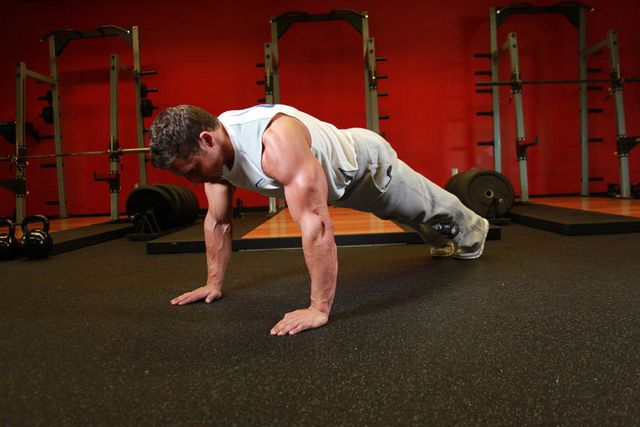
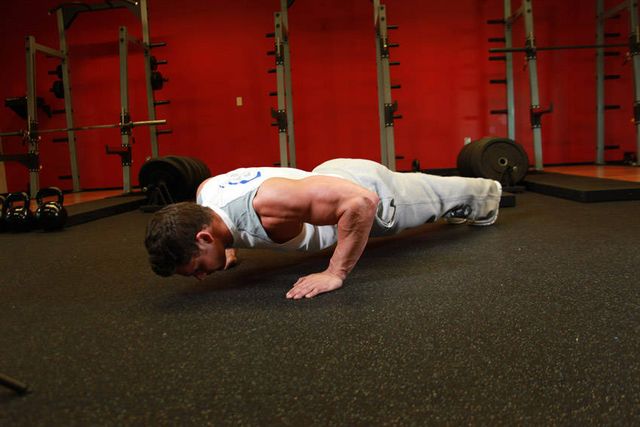
Because the hands are fixed, the roles are reversed: the arm stays fixed and the chest moves. The same pectoralis major contracts, but this time the torso is pulled toward the arm.
What must stay fixed
Body line: one straight line from head to heels.
Lower back: neither sagging nor piked up.
Neck: in line with the spine.
Phases and type of contraction
Phase
What happens
Pectoralis major contraction
Going down
Chest approaches the floor
Eccentric
Coming up
Body moves away from the floor
Concentric
Execution
Hands on the floor slightly wider than shoulder width; body in one line.
Tighten your abdominals and glutes.
Lower by bending the elbows until the chest is near the floor; elbows at about 45 degrees to the trunk.
Push the floor away and rise until the elbows are straight.
Easier and harder
Level
Method
Easier
Hands on a bench or table; or knees on the floor
Harder
Feet on a bench; or a pause at the bottom
Common faults
Fault
What happens in the body
Correction
Lower back sagging
The abdominals are not working and the lumbar vertebrae are compressed
Tighten your abdominals and glutes; easier version
Hips piking up
The load shifts away from the chest to the shoulders
Body in one line
Elbows flaring out to the sides
Stress on the front of the shoulder increases
Bring the elbows closer to the trunk
Head dropping forward
The neck comes under strain
Eyes slightly ahead of the hands
Partial range of motion
The chest does not work in its lengthened position
Lower until near the floor
Coaching cue for the client
“Your body is a flat board; push the floor away from you.”