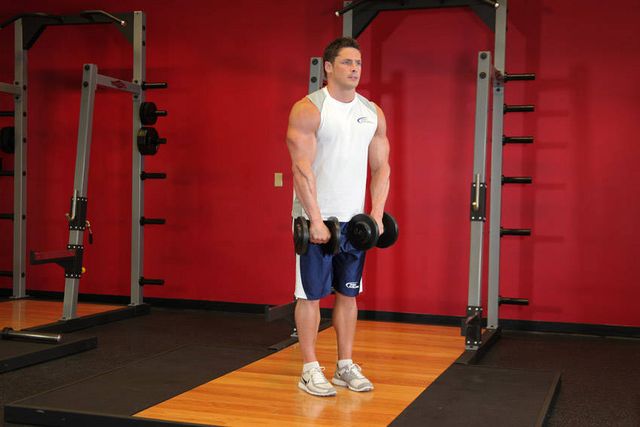
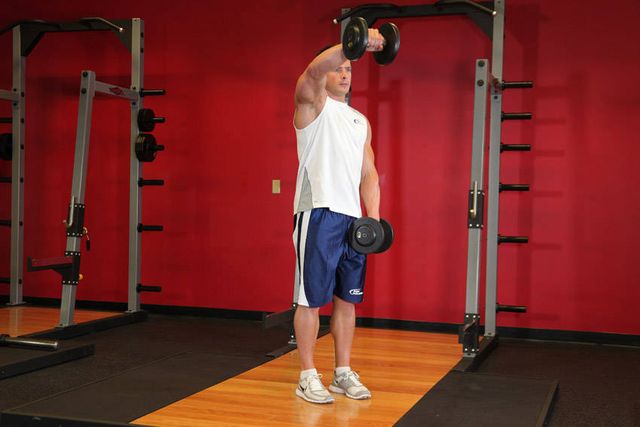
Compare with the lateral raise: same joint, but a different plane. The arm rises to the front, not the side; so a different part of the deltoid works.
Muscles involved
Role
Muscle
Action in this movement
Main
Anterior deltoid
Raises the arm forward
Synergist
Pectoralis major (clavicular part)
Assists shoulder flexion
Synergist
Middle deltoid
Helps a little
Synergist
Upper and lower trapezius, serratus anterior
Rotate the scapula upward
Stabilizer
Rotator cuff muscles
Hold the head of the humerus in the socket
Stabilizer
Core muscles, erector spinae
Keep the trunk from leaning backward
Stabilizer
Forearm muscles
Grip the dumbbell
Antagonist
Latissimus dorsi, posterior deltoid
Must relax
Origin and insertion of the target muscle
Muscle
Origin (fixed)
Insertion (moving)
Anterior deltoid
Lateral third of the clavicle
Deltoid tuberosity of the humerus
What must stay fixed
Torso: straight; the weight is in front of the body and tends to pull the torso into backward flexion.
Elbows: slight, constant bend.
Shoulders: do not rise toward the ears.
Phases and type of contraction
Phase
What happens
Anterior deltoid contraction
Raising
The arm rises to shoulder height
Concentric
Lowering
The arm returns with control
Eccentric
Execution
Stand straight, dumbbells in front of the thighs, palms facing the body.
Brace the abdomen.
Raise the arms forward to shoulder height.
Lower over two to three seconds.
Is this exercise necessary?
The anterior deltoid works in all pressing movements (bench press, push-up, shoulder press). For most beginner clients those exercises are enough, and this one is not a priority.
Common faults
Fault
What happens in the body
Correction
Leaning the trunk back
The lower back arches and momentum lifts the weight
Lighter weight; back against a wall
Raising above shoulder height
The trapezius contributes more and the space under the acromion narrows