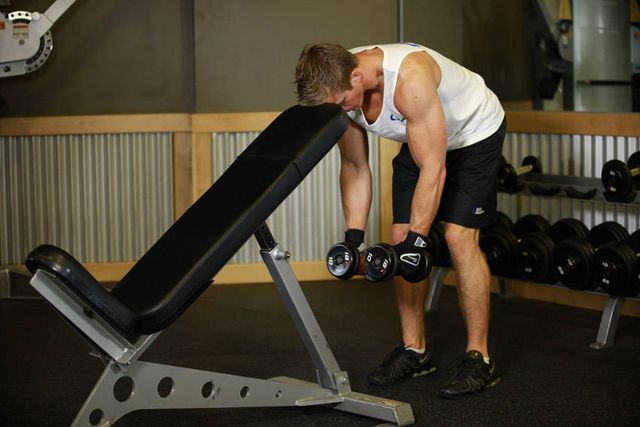
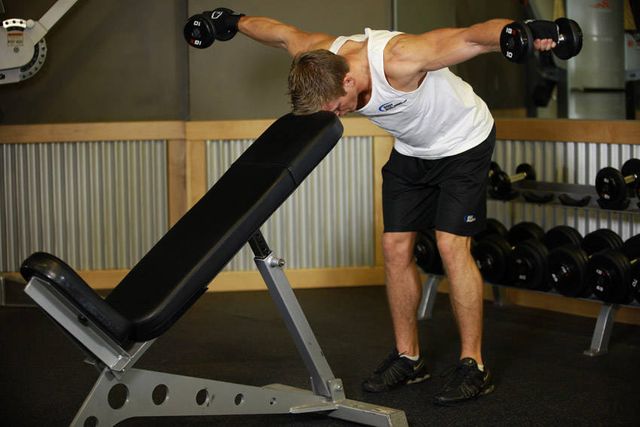
This exercise is exactly the opposite of the dumbbell fly: same joint, same plane, opposite direction. So the muscles that oppose that movement are the main muscles here.
Muscles involved
Role
Muscle
Action in this movement
Main
Posterior deltoid
Moves the arm backward and outward
Main
Middle trapezius, rhomboids
Draw the scapulae together
Synergist
Lower trapezius
Holds the scapula fixed and down
Synergist
Infraspinatus, teres minor
Assist in external rotation and in moving the arm backward
Synergist
Middle deltoid
Helps a little
Stabilizer
Erector spinae
Keeps the lower back straight in the bent-over position
Stabilizer
Gluteus maximus, hamstrings
Hold the hips in the hinged position
Stabilizer
Abdominal muscles, forearm muscles
Tighten the trunk; grip the dumbbell
Antagonist
Pectoralis major, anterior deltoid
Must relax
Origin and insertion of the target muscle
Muscle
Origin (fixed)
Insertion (moving)
Posterior deltoid
Spine of the scapula
Deltoid tuberosity of the humerus
Rhomboids and middle trapezius
Spinous processes of the vertebrae
Scapula
Why this exercise matters
Most programs contain many pressing movements, which strengthen the front of the shoulder and the chest. If the back of the shoulder and the muscles between the scapulae are not trained to match, the shoulders get pulled forward. This exercise restores that balance.
What must stay fixed
Lower back: straight; torso almost parallel to the floor.
Torso angle: does not rise with each repetition.
Elbows: slight, constant bend.
Neck: in line with the spine; eyes on the floor.
Phases and type of contraction
Phase
What happens
Contraction of the target muscles
Raising
Arms rise out to the sides to shoulder level
Concentric
Pause
A moment with the scapulae squeezed together
Static
Lowering
Arms return under the chest under control
Eccentric
Execution
Take the dumbbells, bend the knees slightly and hinge forward at the hips; back straight.
Arms hanging under the chest, palms facing each other, elbows slightly bent.
Raise the arms out to the sides to shoulder level; squeeze the scapulae together.
Lower over two to three seconds.
Alternative for beginners
If the client cannot keep the back straight, have them rest the chest on an incline bench or do the seated version. In this position the lower back carries no load.
Common faults
Fault
What happens in the body
Correction
Trunk rising with each rep
The lower back and hips throw the weight up
Chest supported on the bench; lighter weight
Shrugging the shoulders
The upper trapezius takes over
Shoulders away from the ears
Pulling the elbows back with too much bend
The movement turns into a row and latissimus dorsi works
Arms should open out to the sides, not backward
Rounding of the lower back
The load goes to the lumbar discs and ligaments
Chest up; supported version
Heavy weight
The range shortens and momentum takes the place of the muscle
Light weight with a pause at the top
Coaching cue for the client
“Open your wings and bring your shoulder blades together.”