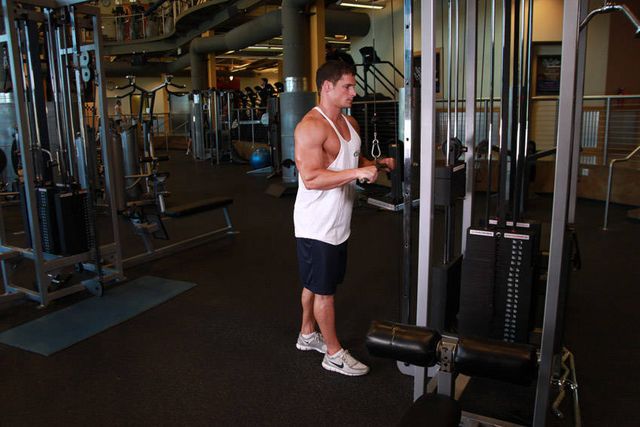
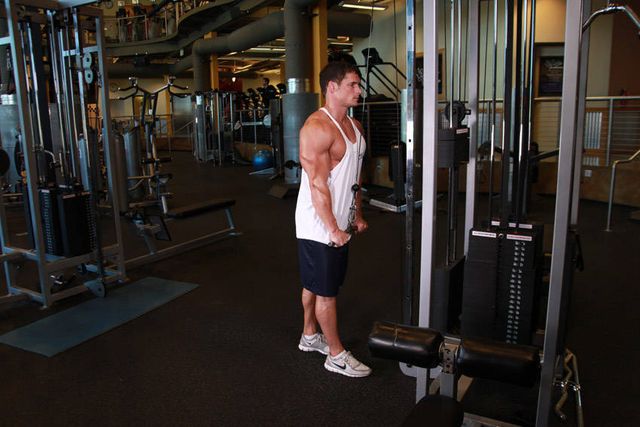
Cable triceps pushdown
Triceps Pushdown
ArmJoint: elbow
Muscles involved, shown on the body
Body map: body-muscles (Apache-2.0) · Sources
At a glance
| Equipment | Cable machine with a straight bar or rope |
| Type | Single-joint |
| Chain | Open |
| Plane of movement | Sagittal |
| Target muscle | Triceps brachii |
Joint movements
| Joint | On the way out (down) | On the way back (up) |
|---|
| Elbow | Extension | Flexion |
| Shoulder, wrist, spine | Fixed | Fixed |
Muscles involved
| Role | Muscle | Action in this movement |
|---|
| Main | Triceps brachii (all three heads) | Extends the elbow |
| Stabilizer | Latissimus dorsi, posterior deltoid, pectoralis major | Keep the arm at the side of the body |
| Stabilizer | Scapular muscles | Hold the scapula down and stable |
| Stabilizer | Forearm muscles | Grip the handle and keep the wrist straight |
| Stabilizer | Core muscles | Hold the trunk fixed |
| Antagonist | Biceps brachii, brachialis | Must relax to allow the elbow to extend |
Origin and insertion of the target muscle
| Head | Origin (fixed) | Insertion (moving) |
|---|
| Long head | Scapula, below the glenoid cavity | Olecranon of the ulna |
| Lateral and medial heads | Back of the humerus | Olecranon of the ulna |
What must stay fixed
- Upper arm: elbow at the side of the body; it does not move forward as the handle rises.
- Shoulder blades: shoulders down and back.
- Wrists: straight.
- Torso: leaning slightly forward and still.
Phases and type of contraction
| Phase | What happens | Triceps contraction |
|---|
| Pushing down | Elbow extends | Concentric |
| Pause at the bottom | Elbow straight | Static |
| Return | Elbow flexes under control | Eccentric |
Execution
- Stand facing the cable machine and grip the handle with your palms facing down.
- Fix the elbows beside the body; forearms almost parallel to the floor.
- Push the handle down until the elbows are straight.
- Return under control until the forearms are parallel to the floor again.
Common faults
| Fault | What happens in the body | Correction |
|---|
| Elbows leaving the body | The shoulder joins the movement and latissimus dorsi and the chest assist | Pin the elbows to your sides |
| Leaning over the handle | Body weight pushes the weight down, not the triceps | Lighter weight; trunk fixed |
| Shoulders rising | Upper trapezius becomes involved | Keep the shoulders down |
| Breaking at the wrist | Stress on the wrist and reduced force transfer | Wrist in line with the forearm |
Coaching cue for the client
“Your elbow is a hinge; open and close only from the elbow.”
← All exercises