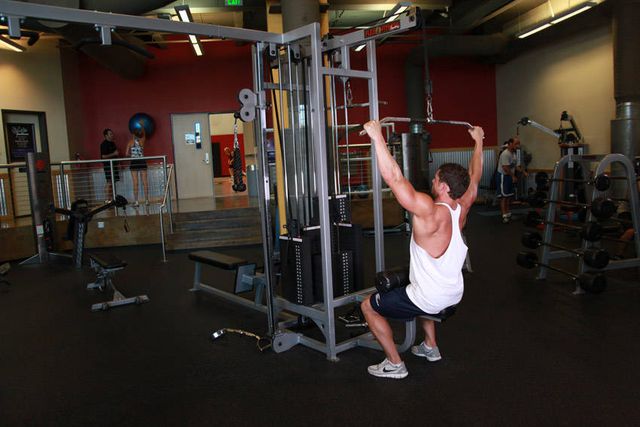
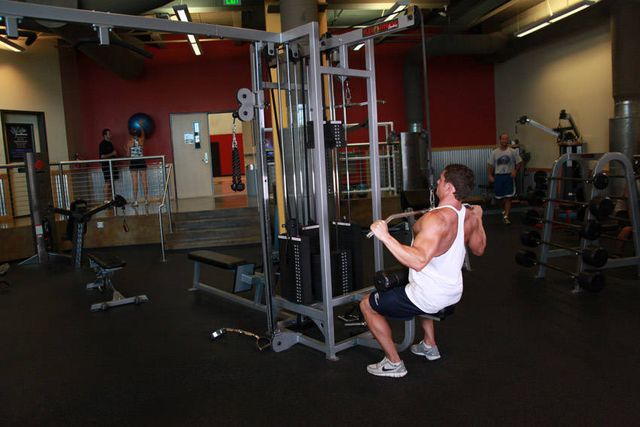
Pulls the arm from overhead to the side of the body
Main
Teres major
The same action as the latissimus dorsi
Synergist
Biceps brachii, brachialis, brachioradialis
Flex the elbow
Synergist
Lower trapezius, rhomboids, pectoralis minor
Pull the scapula down and rotate it
Synergist
Posterior deltoid
Assists in pulling the arm
Stabilizer
Forearm muscles
Grip the bar
Stabilizer
Core muscles, erector spinae
Hold the trunk fixed
Antagonist
Middle deltoid, upper trapezius, triceps brachii
Must relax
Origin and insertion of the target muscle
Muscle
Origin (fixed)
Insertion (moving)
Latissimus dorsi
Lower thoracic and lumbar vertebrae, thoracolumbar fascia, iliac crest
Upper humerus
This muscle connects the lower back and pelvis to the arm. That is why the torso must stay fixed for the arm to be pulled toward it. In the pull-up the same muscle works, but the hands are fixed and the torso rises.
What must stay fixed
Torso: leaning slightly back and still.
Thighs: under the machine pad.
Wrists: straight.
Phases and type of contraction
Phase
What happens
Latissimus dorsi contraction
Pulling down
The bar comes to the upper chest
Concentric
Return
The bar rises with control
Eccentric
Execution
Sit down and secure the thighs under the pad.
Grip the bar slightly wider than shoulder width.
First pull the shoulders down, then drive the elbows toward the sides and down.
Bring the bar to the upper chest.
Return with control until the arms are straight.
Common faults
Fault
What happens in the body
Correction
Leaning back too much
Body weight pulls the bar down; the movement starts to resemble a horizontal row
Keep the trunk fixed; use a lighter weight
Pulling with the arms only
The biceps tires before the latissimus dorsi
Start the movement by pulling the shoulders down
Pulling the bar behind the neck
The shoulder is put in an unfavorable position and the neck is strained
Lower the bar in front of the face
Shoulders staying up by the ears
The upper trapezius stays active and the latissimus dorsi does not contract fully